P-01
Fruit and vegetable purées
Often pumpable but non-Newtonian, with pulp, fibres and temperature-dependent viscosity.
- Ask first
- Viscosity curve, pulp content, fibre length
- Watch
- Fouling, pressure drop, texture change
Applications / product fit
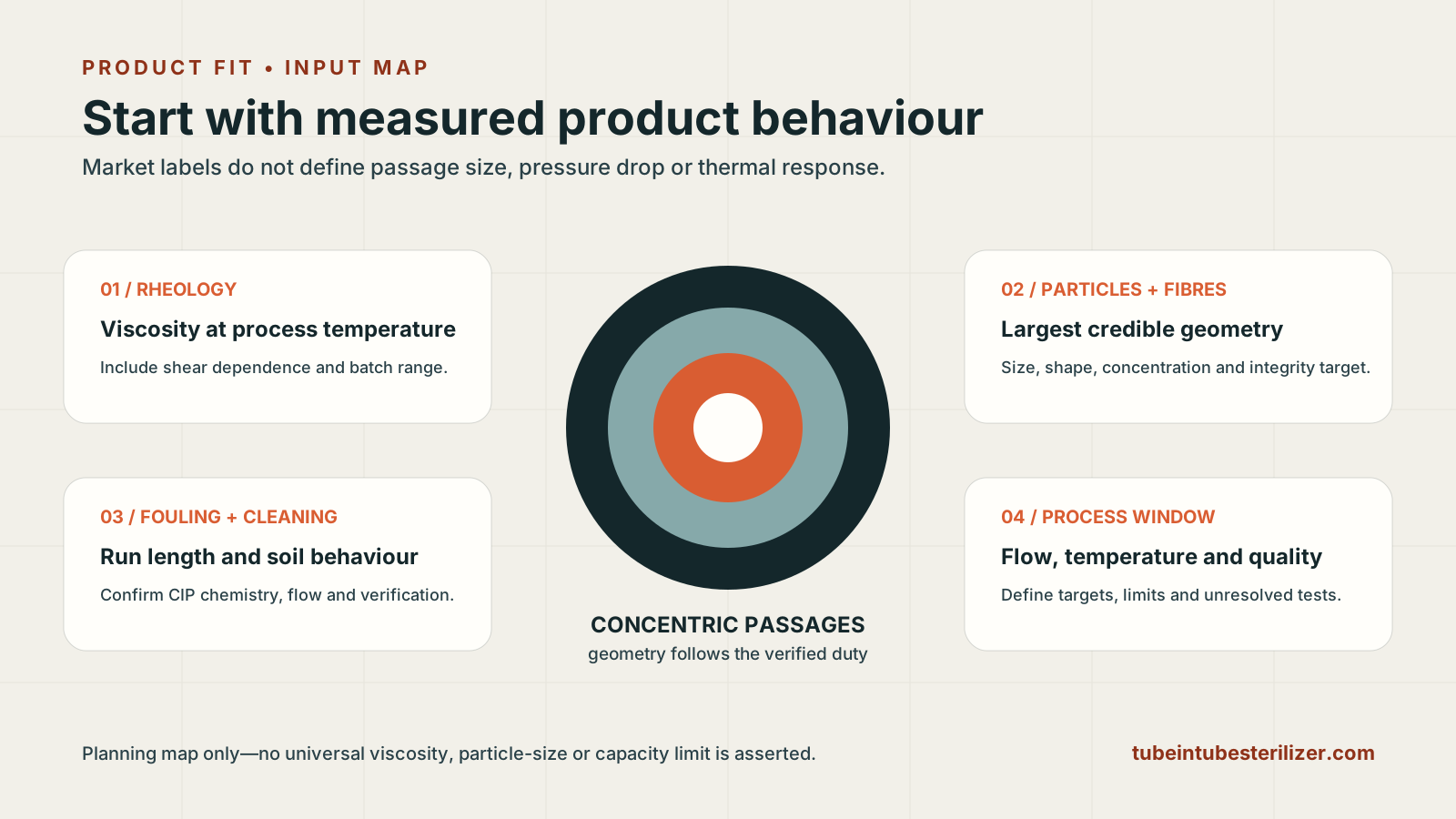
Purée, paste, sauce and concentrate are useful market labels, but equipment fit depends on measurable properties: rheology, particles, fibres, fouling, heat sensitivity, corrosion risk and the required process.
Often pumpable but non-Newtonian, with pulp, fibres and temperature-dependent viscosity.
Concentration, Brix, temperature and shear history can materially change flow behaviour.
Formulations may combine a viscous carrier with discrete pieces that must survive pumping and thermal treatment.
Sugar, solids, pectin and fruit pieces can influence heat transfer, viscosity and cleaning demand.
Fibres or soft particles may rule out narrow passages even when the liquid phase is not highly viscous.
Dairy desserts, plant-based products and liquid foods with particulates may be candidates after a product-specific review.
Particle fit
Describe the largest particle in three dimensions, not only a nominal diameter. Include shape, concentration, hardness, fibre length, breakage sensitivity and whether the product can be sampled.
Pump clearance, pressure drop, heat penetration, residence time, filler interface and desired particle integrity all belong to the decision.
Screening matrix
| Product signal | Tube-in-tube review | Comparison question | Evidence still needed |
|---|---|---|---|
| Viscous, pumpable, limited solids | Candidate to evaluate | Which geometry manages pressure drop and run length? | Rheology curve and fouling trial |
| Fibres or soft particulates | Geometry-specific candidate to evaluate | Which passage and pump protect clearance and integrity? | Three-axis particle distribution |
| Low-viscosity homogeneous liquid | One option to evaluate | Which concept meets the duty and project economics? | Run length, pressure and economics |
| Large, hard or fragile pieces | Fit unknown without product evidence | What passage, pump and filler clearances are required? | Integrity target and sample trial |
| Severe burn-on tendency | Fit unknown without run-length evidence | What test can compare viable heating concepts? | Representative sample testing |
This matrix is a planning aid, not a performance guarantee or process validation.
Fit starts with a sample description
Product data and representative samples make the first equipment conversation faster and more responsible.
Request a quotation