Product passage
Rheology, particles, fibres, pressure drop and fouling affect tube geometry, pumps, area and the evidence needed before design freeze.
Procurement guide / cost and scope
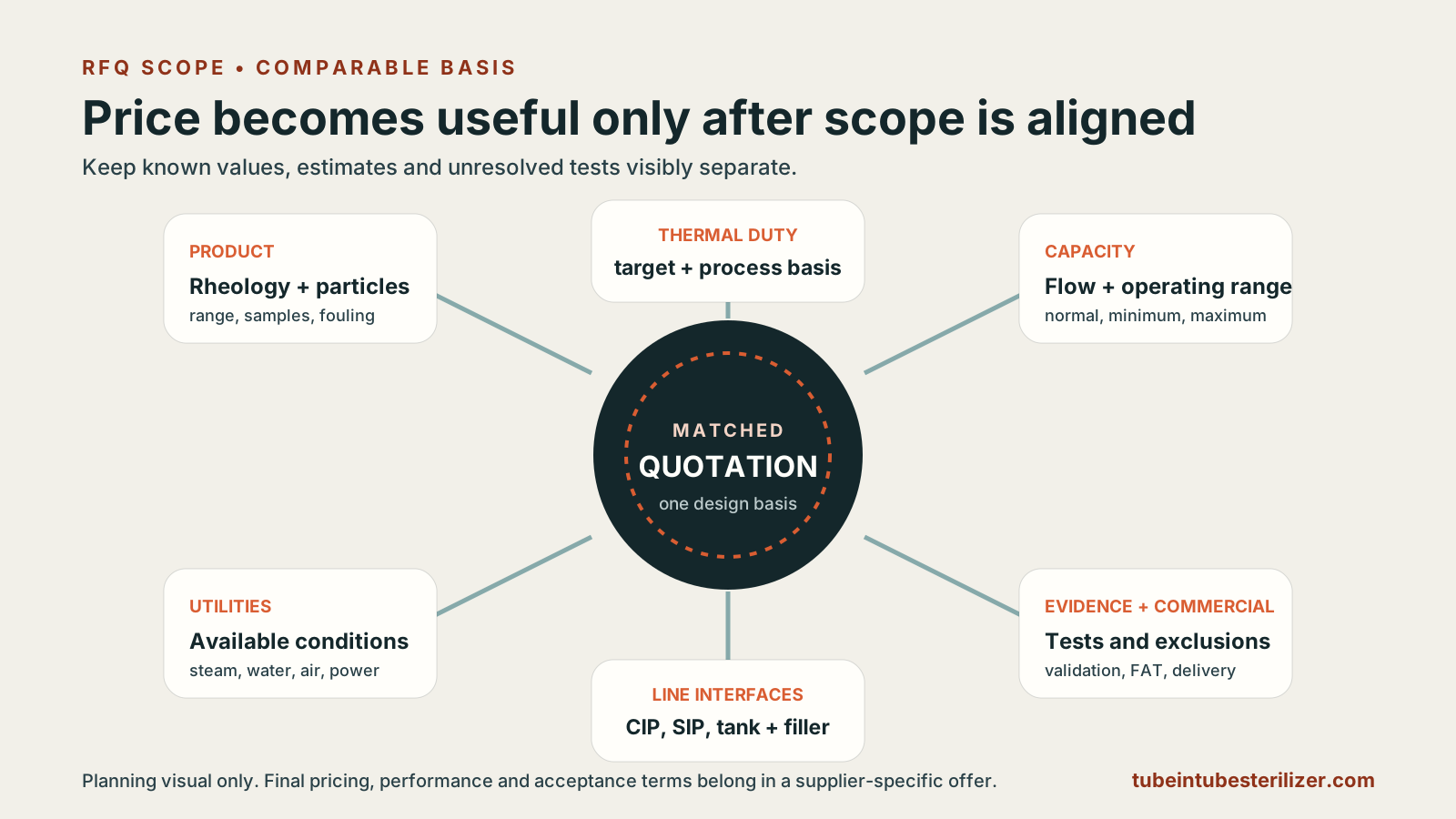
A tube-in-tube sterilizer does not have one responsible global price. Product behaviour, thermal duty, heat-transfer area, pressure rating, automation, recovery, cleaning, documentation and the line boundary can turn two similarly named quotations into materially different projects.
Direct answer
Rheology, particles, fibres, pressure drop and fouling affect tube geometry, pumps, area and the evidence needed before design freeze.
Inlet, process, holding and outlet conditions affect heating, regeneration, cooling, utilities, controls and operating range.
Materials, finishes, seals, weld records, CIP, SIP, diversion and the downstream sterile zone change engineering and documentation scope.
Feed equipment, aseptic tank or filler, utility systems, control handshakes and site constraints can sit inside or outside the quotation.
Product trials, design review, FAT, SAT, process support, training and commissioning should be priced against defined deliverables.
Freight, taxes, installation, travel, local works, spares, warranty and payment terms must be aligned before totals are compared.
Like-for-like matrix
Use this as a review structure. It does not imply that every project needs every item.
| Scope block | Confirm in each offer | Common comparison risk |
|---|---|---|
| Design basis | Product, nominal and permitted flow range, inlet, thermal and outlet conditions | Offers use different duties or assumed properties |
| Process equipment | Feed, heating, hold, cooling, regeneration, divert and product recovery | A required section may be excluded from the total |
| Pumps and controls | Pump type, instruments, PLC/HMI, recipes, records and interface signals | Control or recording scope is left to others |
| CIP and SIP | Circuits, valves, return, pre-sterilization boundary and included utility equipment | “CIP-ready” is mistaken for a complete cleaning system |
| Documentation | Drawings, material, surface, weld, test, software and operating records | Acceptance needs evidence not included in the offer |
| Site services | Installation, supervision, commissioning, training, trials, travel and local works | Site costs may surface only after purchase |
| Commercial terms | Currency, validity, taxes, freight, delivery basis, warranty, spares and payment | Totals are compared on different commercial bases |
Capital scope
Operating scope
No invented number
If early data are incomplete, request a budgetary estimate with explicit assumptions, exclusions and accuracy limitations. Do not present it as a firm equipment price or lifetime-cost result.
Procurement review
A matched RFQ makes the technical gaps visible and reduces the chance that the cheapest headline total is simply the narrowest scope.
Request a quotation