01 / Product state
Define hot-break or cold-break context, formulation, Brix, density, inlet temperature and whether dilution or evaporation occurs upstream.
Application guide / tomato paste
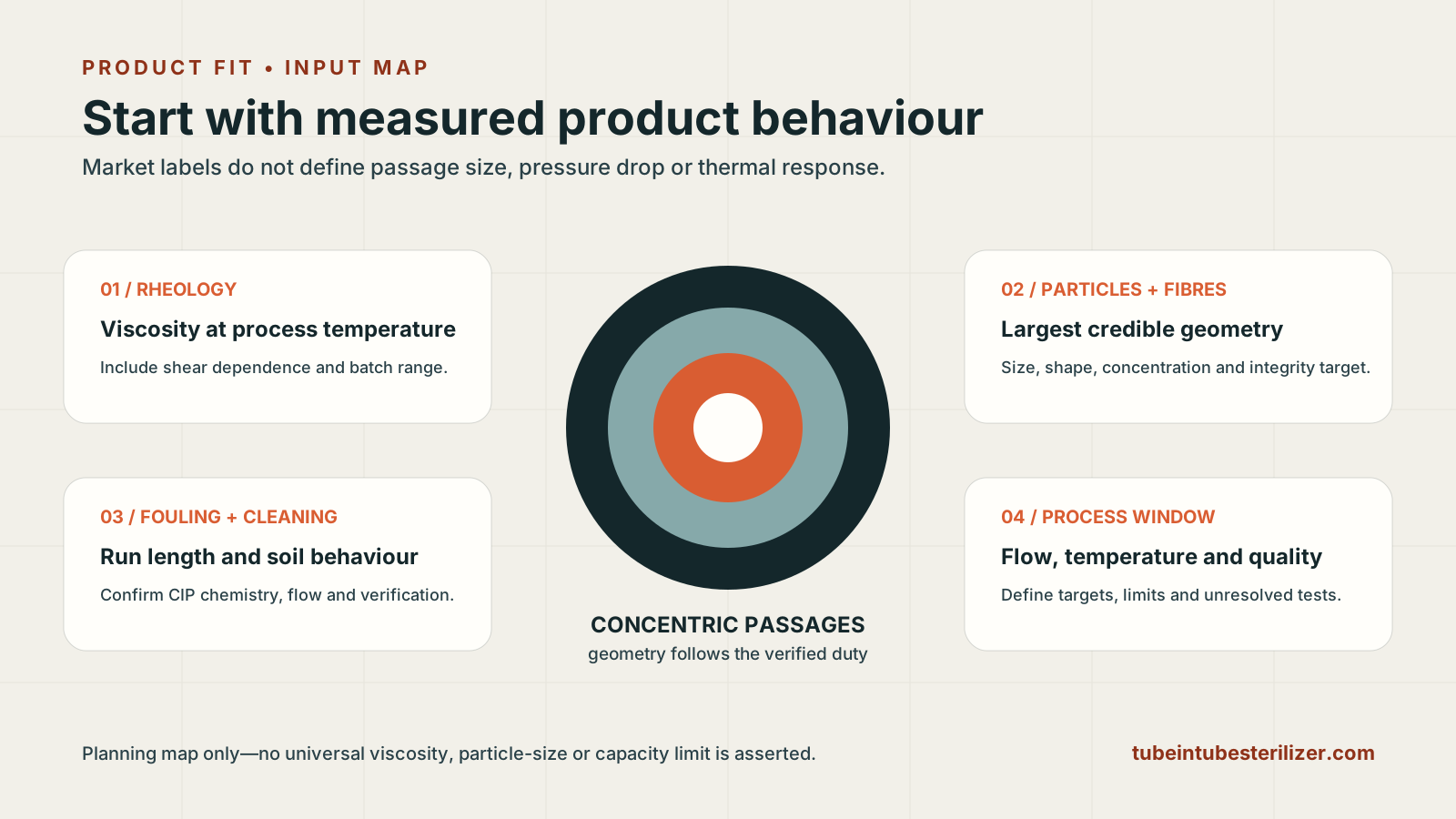
Tomato paste is often a strong reason to evaluate a tubular path, but the product name does not size the exchanger. Concentration, temperature, shear history and formulation change flow behaviour; the proposed pump, tube geometry, thermal duty and aseptic boundary must therefore be assessed together.
Direct answer
It can be a candidate when a pumpable paste needs an indirect, defined product passage, but suitability is conditional. The project must demonstrate manageable pressure drop, adequate heat transfer, the required minimum thermal treatment, acceptable quality change, a practical run length and effective cleaning for the exact paste.
Brix is not a rheology model. Record the analytical method and soluble-solids value, then add viscosity or flow-curve data at relevant temperatures and shear conditions. Published tomato-paste studies likewise use measured, temperature-dependent properties rather than a product label as the design input.
Design basis
Define hot-break or cold-break context, formulation, Brix, density, inlet temperature and whether dilution or evaporation occurs upstream.
Provide the test method, temperature range, shear range and fitted flow behaviour. A single cold viscosity can misstate pump and pressure-drop duty.
State inlet, scheduled process where applicable, holding requirement and outlet condition. Preserve the process authority's assumptions and limits.
Match pump type, tube passage, nominal and maximum permitted flow, pressure rating and downstream backpressure.
Define the required campaign duration, evidence for heat-transfer decline or pressure rise, and the trigger for cleaning.
Close diversion, cooling, sterile-zone pressure, tank or bag-filler connection, controls and package assumptions as one boundary.
Process path
Confirm product state and control the flow variable used by the thermal-process basis.
Use measured properties and a project model or representative trial to establish area, utility duty and pressure drop.
Link holding geometry to the maximum permitted flow and fastest product path, not only the nominal average.
Define outlet temperature, backpressure and the sterile transfer interface before fixing equipment scope.
Evidence before promise
A trial plan should record formulation, age, inlet condition, flow, temperatures, pressure, run duration and the agreed before/after quality measurements. A water test cannot establish paste fouling, texture or real pressure drop.
Research basis
These papers support the need to measure viscous-food and tomato-paste properties. They do not validate a Site34 design or supply a universal operating envelope.
Tomato-paste review
The first review should return a list of confirmed inputs, unresolved tests and a matched supply boundary—not an unsupported capacity promise.
Request a quotation