01
Product behaviour
Rheology across the real process window
A single room-temperature viscosity can be misleading. Record test method, temperature, shear condition and whether the product is shear-thinning, time-dependent or prone to separation.
Selection / engineering inputs
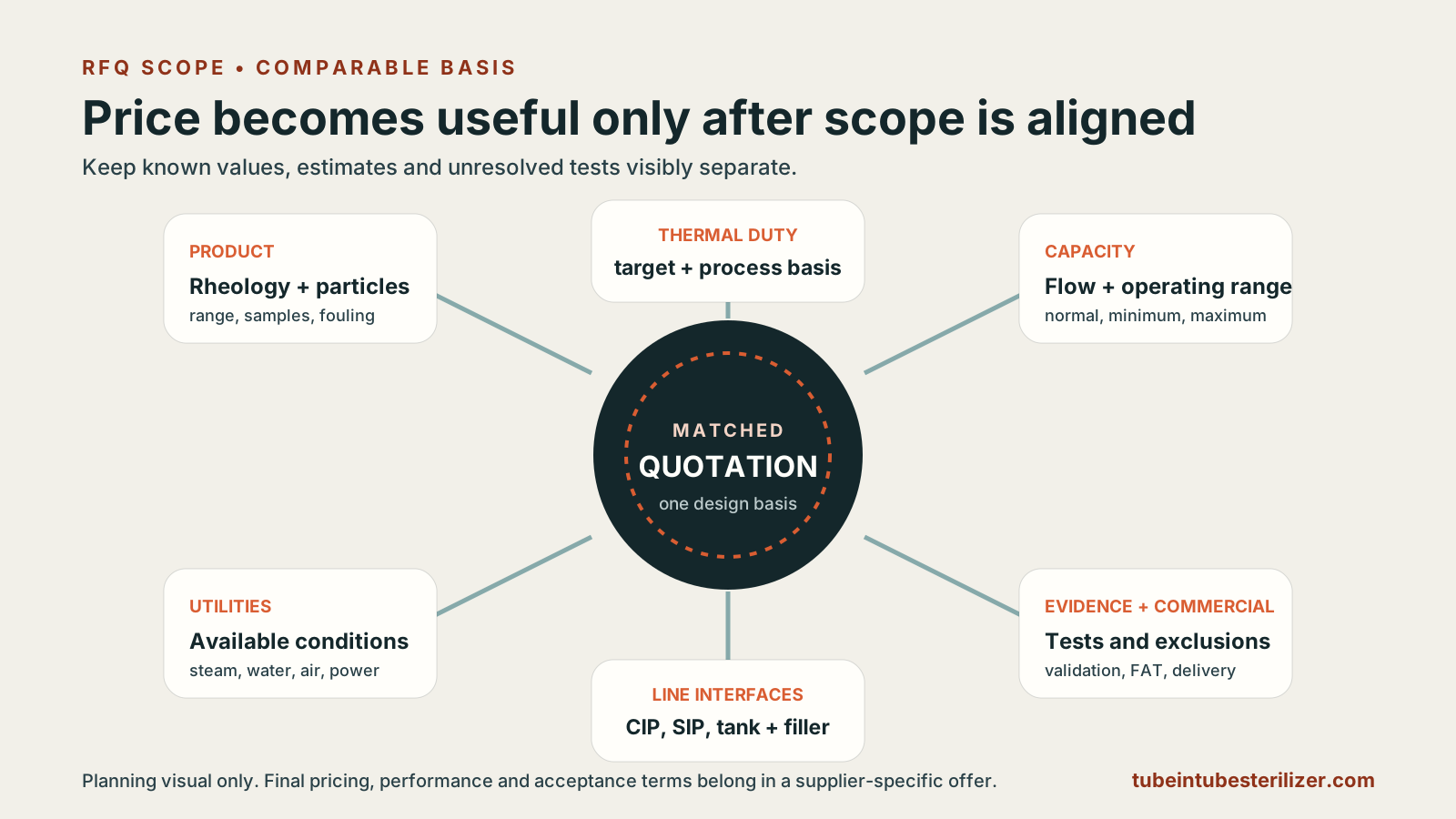
Capacity and price are outputs of a defined scope. Collect the product and line data below before comparing offers—or risk comparing equipment designed for different duties.
Product behaviour
A single room-temperature viscosity can be misleading. Record test method, temperature, shear condition and whether the product is shear-thinning, time-dependent or prone to separation.
Solids and structure
Describe maximum particle dimensions on three axes, distribution, shape, concentration, hardness, fibre length and the acceptable change after pumping and heating.
Thermal duty
Provide inlet condition, the process authority's target where applicable, required hold, outlet condition and any quality constraints. Do not substitute a competitor's standard temperature.
Production duty
State nominal and minimum throughput, campaign length, product changes, starts and stops, upstream supply stability and downstream filler capacity. Turndown can change residence time, heat load, overprocessing risk, pressure drop and line balance; it is a process condition, not only a production target.
Hygiene
List the deposit-forming ingredients, existing CIP station, chemicals, temperature, available flow, return path and validation expectations. CIP removes soil; a validated SIP cycle is used to establish the required pre-production hygienic condition within its defined boundary.
Interfaces
Identify steam or hot-water supply, cooling circuits, electricity, compressed air, available space, control handshakes and the exact tank or filler interface.
Pricing logic
There is no reliable universal price independent of product duty and supply boundary. Two systems carrying the same product label can have different tube geometry, heat-transfer area, pressure rating, pump duty, recovery arrangement, controls, cleaning scope and filler interface.
Use the cost and quote-scope matrixDefine duty Product, flow, thermal target and outlet condition.
Define boundary Included pumps, tanks, cooling, CIP/SIP and filler interface.
Define proof Trials, documentation, inspection, acceptance and commissioning scope.
Compare like-for-like Commercial terms only make sense after the technical boundary matches.
Procurement boundary
Ask for a matched evidence and service scope. These are procurement questions, not claims about an unverified Site34 machine.
Which wetted materials, elastomers and utility-side materials are proposed, and how will compatibility be reviewed?
Which surface-finish, weld, passivation, inspection and traceability documents are included?
What are the design and working pressures, governing code assumptions, test method and relief boundaries?
How are drainability, inspection access, product recovery and hold-up addressed in the proposed geometry?
Which tests, documents, commissioning steps and acceptance criteria are included, witnessed or excluded?
Which seals, instruments and wear parts need planned stock, and what access, tools, training and warranty scope apply?
Complex products
When rheology, particles, fouling or quality targets are uncertain, a representative sample and agreed test protocol can reduce configuration risk. The test must reflect the real formulation and processing temperature.
Prepare the brief
The RFQ form follows this selection logic and does not require invented numbers.
Request a quotation