CONTINUOUS THERMAL PROCESSING · PURÉE / PASTE / CONCENTRATEsales@tubeintubesterilizer.com

Process architecture / UHT heating method

Direct vs indirect UHT processing for food.

Direct and indirect UHT systems differ first in how heat reaches the product. Direct systems condense steam into the product; indirect systems transfer heat across a physical surface. That choice changes the utility boundary, mass balance, equipment train, controls and evidence plan, so it should be made against one defined product and quality target.

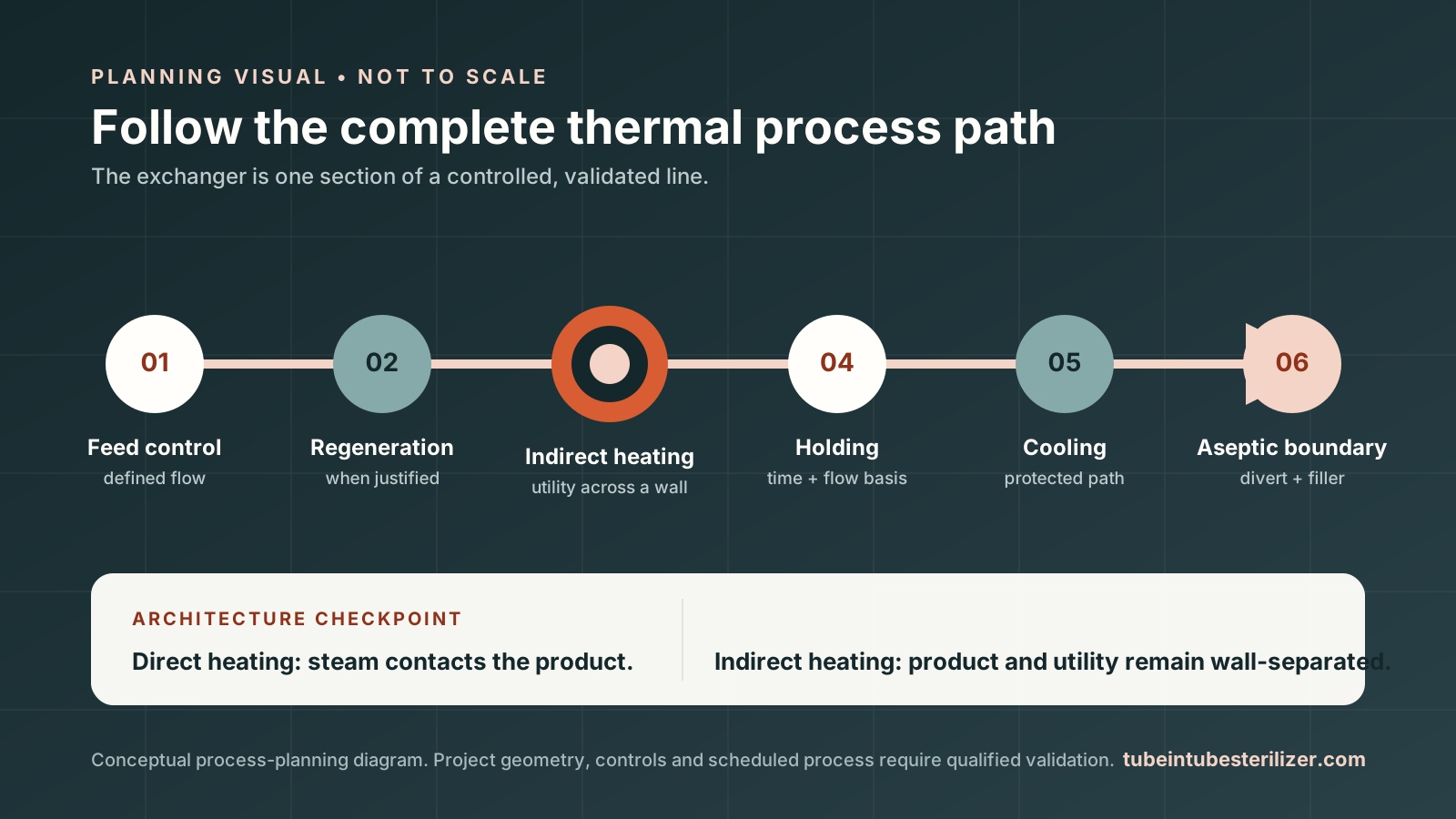
Conceptual thermal-process path with an architecture checkpoint distinguishing direct product contact from indirect wall-separated heating
Process illustration. Direct and indirect heating change the process boundary; neither label establishes the right project choice by itself.

Direct answer

What is the difference between direct and indirect UHT heating?

In direct steam injection or infusion, qualified steam contacts and condenses into the food. The process design must account for steam quality, added condensate, product expansion, holding, downstream flash or cooling arrangements, and the final composition. In indirect heating, product and service media remain separated by a plate, tube or other heat-transfer surface.

Neither description proves that a system suits a specific food. Rheology, particles, heat sensitivity, fouling, required production window, energy boundary, packaging interface and the scheduled process all remain project inputs.
Steam contacts product

Direct UHT screening logic

Injection introduces steam into a moving product stream; infusion exposes droplets or a film to a steam environment. A downstream vacuum or flash step may form part of the temperature and water-balance strategy. Review every product-contact utility and downstream control as part of the process boundary.

  • Steam specification and contaminant controls
  • Condensate addition and final solids balance
  • Expansion, hold and flash-vessel behaviour
  • Volatile, flavour and texture acceptance

Surface separates media

Indirect tubular screening logic

A tube wall separates product from heating or cooling media. The design then depends on heat-transfer area, temperature driving force, product-side hydraulics, wall condition, regeneration, fouling and cleaning. Tube-in-tube is one indirect architecture, not a synonym for every UHT system.

  • Measured rheology and thermal properties
  • Passage, pressure drop and pump duty
  • Wall temperature, fouling and run length
  • Recovery, CIP and inspection boundary

Matched comparison

Compare one product, duty and acceptance plan

The table frames questions; it does not assign a universal advantage to either method.

Decision evidence for comparing direct steam and indirect tubular UHT systems
Decision variableDirect-heating questionIndirect-heating questionEvidence to align
Product contactWhat steam specification and safeguards apply?What surface, joint and pressure boundary separates product and utility?Utility specification, materials and hazard review
Mass balanceHow are condensed steam and any flash removal accounted for?How do heating, cooling and regeneration affect the product without utility contact?Product, water, solids and volatile balance
Product behaviourCan injection or infusion, expansion and downstream handling preserve acceptance?Can the passage, pump and wall duty preserve acceptance?Representative-product trial and before/after tests
Flow and holdWhere is flow controlled, and how are expansion and fastest-path assumptions handled?How do measured flow, usable geometry and rheology define the holding basis?Approved model, instruments and residence-time evidence
Run lengthWhich product-contact zones can foul, and what ends a run?How do wall deposition and pressure or heat-transfer trends end a run?Defined campaign and cleaning trigger
Utilities and recoveryWhat steam, vacuum, cooling and recovery boundary is included?What heating, cooling, regeneration and pump boundary is included?Matched utility balance at the design duty
Aseptic boundaryHow are heating, hold, cooling, diversion, sterile-zone equipment and packaging protected and recorded?Process narrative, cause-and-effect and acceptance plan

Input boundary

Six facts needed before architecture selection

01 / Product scope

Define formulation, pH, solids, density, rheology, particles, fibres, entrained gas and credible batch variation.

02 / Thermal basis

Record inlet, scheduled process where applicable, holding requirement, outlet and maximum permitted flow.

03 / Quality target

Choose measurable criteria for flavour, colour, nutrient, texture, separation and particle integrity.

04 / Utility reality

Characterize steam, water, cooling, vacuum, power, condensate, recovery opportunities and plant constraints.

05 / Production window

Define nominal and turndown flow, campaign length, startups, product changes, cleaning time and acceptable losses.

06 / Complete line

Include homogenization where relevant, holding, cooling, diversion, buffer strategy, filler and packaging controls.

Evidence boundary

Architecture definitions are broad; performance evidence is product-specific

The FDA sources distinguish direct and indirect systems in U.S. low-acid aseptic-processing guidance and filing instructions. The research comparison below used protein-enriched skim-milk beverages at pilot scale; it demonstrates that heating method can change measured product outcomes, not that its result transfers to other foods.

Regulatory guidance

  1. U.S. FDA — Aseptic Processing and Packaging for the Food IndustryDefines direct steam, indirect surface and ohmic heating categories within the guide's U.S. inspection scope.
  2. U.S. FDA — Form 2541g instructionsSeparates direct and indirect heating inputs and identifies flow and expansion information used in the stated filing scope.

Scoped research example

  1. Pilot comparison of direct injection, infusion and tubular heatingProtein-enriched skim-milk beverage study; useful for method and acceptance planning, not a universal food-performance ranking.
≠

No universal winner

Fast heating, heat recovery or an open passage cannot select the process alone.

Each apparent benefit sits inside a different product, utility, control and commercial boundary. Compare the complete line using measured product data and the same acceptance criteria.

Build the comparison basis

Architecture review

Bring one product brief to both process concepts.

The review should identify what is known, what must be tested and which boundary makes the decision—not manufacture a universal answer.

Request a quotation
Discuss your equipment