CONTINUOUS THERMAL PROCESSING · PURÉE / PASTE / CONCENTRATEsales@tubeintubesterilizer.com

Application guide / fruit purée and pulp

Tube-in-tube sterilizer for fruit purée and pulp.

Fruit purée and pulp can vary with cultivar, maturity, screen size, formulation, temperature and storage history. A useful tube-in-tube review describes that variation and the quality target instead of treating every purée as the same homogeneous liquid.

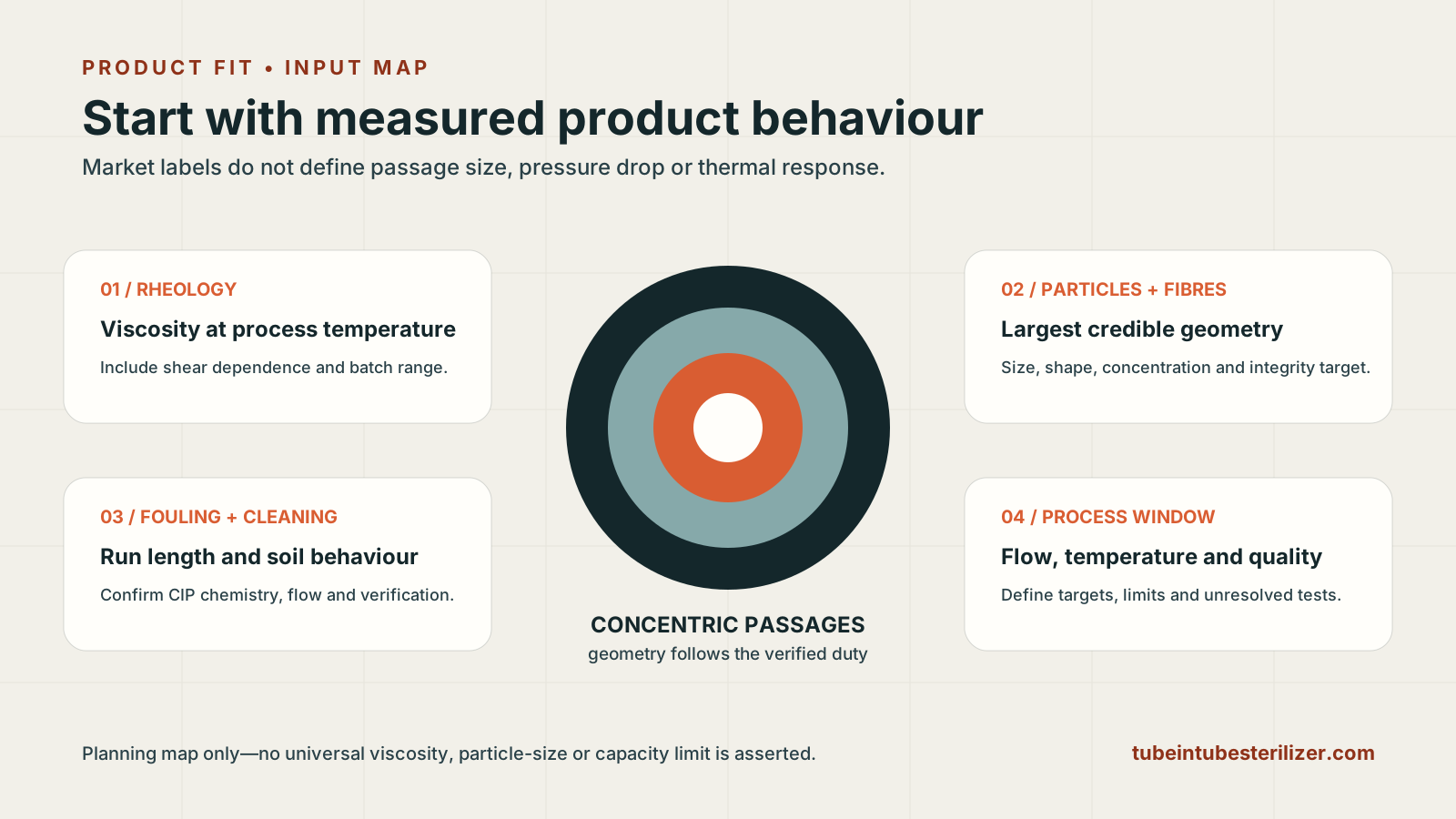
Fruit-puree and pulp process-fit input map covering viscosity, fibres and particles, fouling and cleaning, and the process window
Process illustration. Fruit type, preparation and batch variation change the input envelope; representative samples remain valuable.

Continuous phase

Characterize the carrier

Record density and rheology across the expected process-temperature and shear window. Note added sugar, starch, pectin or other formulation changes, plus any settling or phase-separation tendency before and after heating.

  • Measurement method and temperature
  • Viscosity or flow curve
  • Total and soluble solids
  • Air entrainment and separation

Dispersed phase

Describe what must pass intact

Fibres, seeds, pulp and pieces affect passage clearance, pump choice, heat transfer and residence behaviour. Give the distribution and maximum dimensions on three axes, concentration, hardness and the acceptable post-process integrity.

  • Three-axis size distribution
  • Fibre length and orientation
  • Particle concentration
  • Breakage and texture target

Fit questions

Six checks before selecting the product passage

Can it be fed consistently?

Confirm upstream mixing, deaeration, level control and pump conditions so the sterilizer receives the defined formulation and flow.

Will the passage stay clear?

Compare particle and fibre dimensions with every restriction: pump, valves, tube transitions, instruments and downstream filler.

What is the fastest path?

Non-Newtonian flow and particulate motion can make average residence time an incomplete safety basis. The validation plan must address the actual product.

Will quality survive?

Set measurable acceptance for colour, flavour, aroma, separation, texture and particle integrity after pumping, heating, holding and cooling.

How long can the run remain controlled?

Define fouling indicators, pressure or temperature trends, the required campaign duration and a validated cleaning endpoint.

Does the filler accept the product?

Match outlet temperature, pressure, particle clearance, buffer strategy, sterilization sequence and control handshake.

Sample and acceptance plan

Make the product trial answer a design question

Minimum context for a representative fruit-purée or pulp trial
RecordWhy it mattersExample acceptance evidence
Formulation and batch stateConfirms the tested product represents productionRecipe class, cultivar, maturity, screen and storage history
Operating conditionsLinks outcome to flow, temperature, pressure and run timeTimestamped instrument trend and sample points
Particle and fibre outcomeTests passage and pump effectsBefore/after distribution and agreed integrity check
Quality outcomeBalances thermal duty with product valueDefined colour, flavour, texture or separation method
Cleaning outcomeTests recoverability after a representative runAgreed visual, chemical or hygienic verification method

Research basis

Residence behaviour and product quality need direct evidence

These studies illustrate product-specific thermal and particle behaviour. They are not universal limits and do not establish a scheduled process for a Site34 project.

Peer-reviewed studies

  1. Heat transfer in tubular exchangers for particulate-containing liquid foodsExperimental context for product-specific particle concentration and heat-transfer behaviour.
  2. Particle residence time in continuous food processingShows why particle behaviour belongs in a product-specific validation plan.
  3. Heat transfer during thermal processing of banana puréeExample of linking a temperature-dependent purée, exchanger geometry and operating conditions.

Fruit-process review

Define the worst credible product, not only the average batch.

Use the RFQ brief to separate measured values, expected variation, acceptance criteria and the tests still needed.

Request a quotation
Discuss your equipment