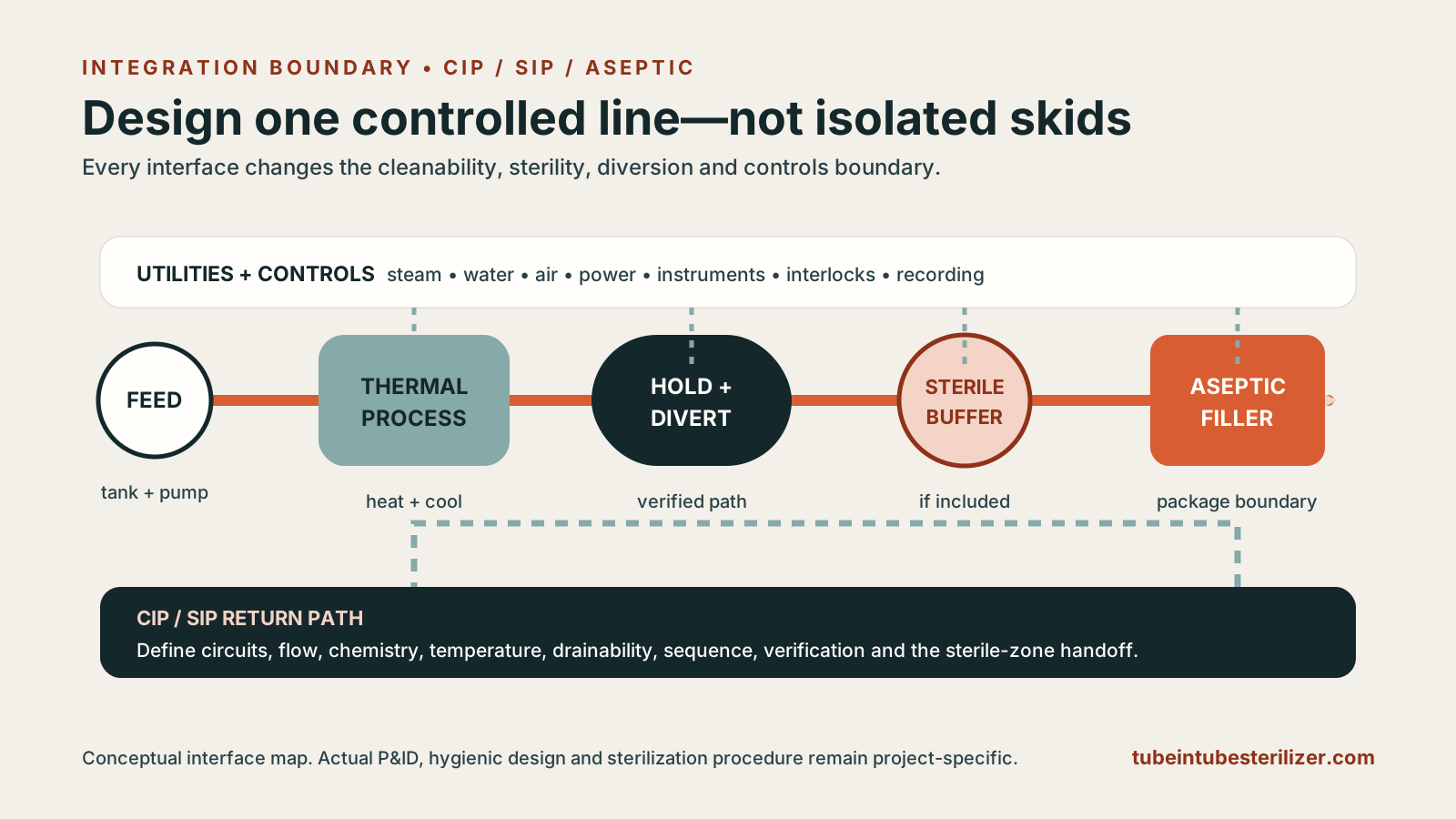
Cleaning and sterile preparation are different duties. A tube-in-tube sterilizer needs a defined cleaning circuit, suitable return conditions and access to the surfaces that contact product. If the outlet belongs to an aseptic process, the sterile-preparation boundary must also be established.
Process illustration. Illustration of the inputs and interfaces discussed in this guide. Final details are established for the project. Scroll the diagram horizontally to inspect it.
Configuration priorities
What to specify for this duty.
01
Define the CIP supply and return
Identify whether the equipment uses an existing cleaning station or a separately supplied package. Describe product residues and the planned changeover pattern. Flow coverage, return path, chemicals, temperature and verification belong to the cleaning assessment; cleanable hardware alone is not a validated cleaning result.
02
Map valves and difficult interfaces
The review should include the product feed path, exchanger, holding assembly, outlet and valves. Ask which circuits are cleaned together and which are isolated. Instruments, seal compatibility and low-flow or trapped areas need attention in the actual design rather than a generic diagram.
03
Agree the sterile-preparation boundary
Where SIP is part of the process, specify the defined circuit, instrumentation and transition to production. Do not assume that a CIP connection also establishes a sterilization procedure. Responsibility for downstream tanks, fillers and their sterile barriers should be documented in the equipment scope.
A useful first enquiry
Bring the product. We’ll discuss the equipment.
You do not need every value to start. Share what is known and identify what needs review. A clear product brief helps define configuration, included modules and the decisions that affect the quotation.
Product residue and fouling history
Existing CIP station and utility conditions
Required cleaning verification method
Aseptic circuit, valves and sterile-preparation responsibility
Practical answers
Before you specify.
Is a CIP station included?
Only if it is specified in the supply scope. Share the existing station details if you intend to reuse it.
Do you publish a universal chemical recipe?
No. The cleaning method depends on the product, circuit, materials and validation requirements.
Discuss your equipment
From product requirements to a defined scope.
Send your product, target flow and packaging needs. The equipment quotation should identify what is included, what connects to your existing line and which process values still need confirmation.
Plan tube-in-tube sterilizer inspection, cleaning access, seals, instruments and service space. Define maintenance documentation and spare-parts scope before purchase.
Compare SUS304 and SUS316L contact-material options for a tube-in-tube sterilizer. Define product chemistry, cleaning compatibility, seals and scope documentation.