CONTINUOUS THERMAL PROCESSING · PURÉE / PASTE / CONCENTRATEsales@tubeintubesterilizer.com

Technology comparison / fouling and shear

Tube-in-tube vs scraped-surface heat exchanger.

Tube-in-tube and scraped-surface heat exchangers are both considered for difficult food products, but they manage the product-wall interaction differently. The decision should fix one product, thermal duty, flow range, run length, quality target and cleaning requirement before comparing machinery.

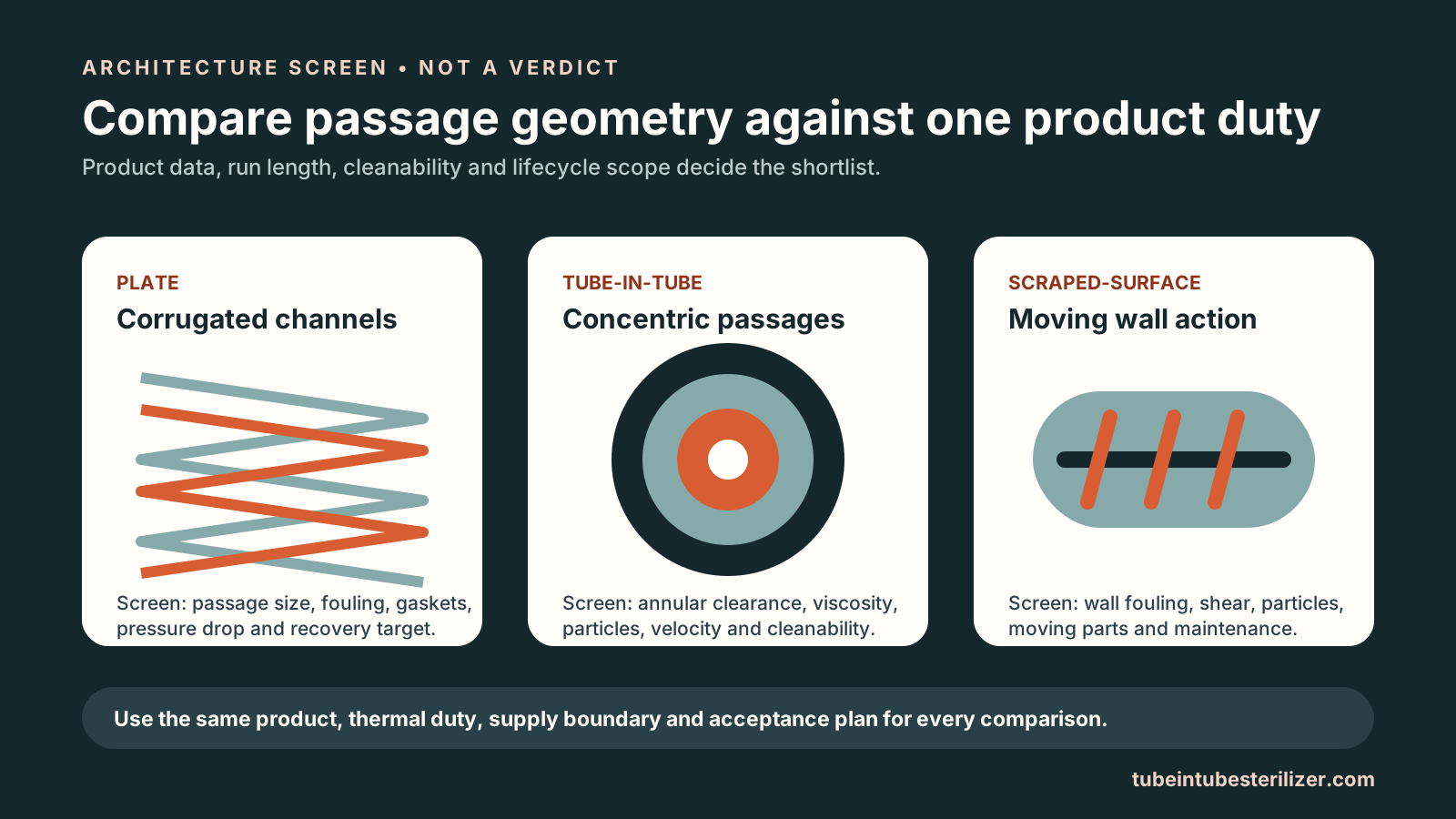
Conceptual comparison of tube-in-tube, plate and scraped-surface heat exchanger passage and wall-action architectures
Process illustration. Fouling, shear, particles, cleaning and maintenance should be screened against one product and operating plan.

Stationary tubular passage

Tube-in-tube screening logic

A concentric product passage has no internal scraping mechanism. Geometry, velocity, wall temperature, product properties and cleaning strategy must keep heat transfer, pressure drop and fouling within the project envelope.

  • Defined stationary product passage
  • No rotating scraper in the heat-transfer zone
  • Hydraulics and wall condition drive performance
  • Representative fouling evidence may be required

Continuously renewed wall

Scraped-surface screening logic

Rotating blades or similar elements can disrupt the wall boundary layer and remove deposits while the product is processed. That mechanism can help selected viscous or fouling duties, but it introduces mechanical shear, wear parts, drive requirements and additional maintenance variables.

  • Active wall renewal during operation
  • Rotor speed and clearance affect product treatment
  • Wear, seals, alignment and drive duty matter
  • Cleaning and inspection must include scraper components
Matched comparison

Ask the same engineering question of both concepts

Project questions for comparing stationary tubular and scraped-surface heat-transfer paths
Decision variableTube-in-tube questionScraped-surface questionEvidence
FoulingCan velocity, wall duty and circuit design support the required run?Can wall renewal sustain duty without unacceptable wear or product change?Representative run with heat-transfer and pressure trends
Viscosity and pressureWhat passage and pump meet the flow range?What rotor, annulus and pump duty meet the same range?Process-temperature rheology and hydraulic model
Shear and qualityWhat pumping and passage effects occur?What blade speed, clearance and residence effects occur?Defined before/after quality measurements
ParticlesDo pump, valves and tube restrictions protect clearance and integrity?Do rotor, blade, gap and outlet protect clearance and integrity?Three-axis distribution, concentration and hardness
CleaningCan the full stationary circuit meet the CIP endpoint?Can product-contact scraper parts and clearances meet it?Documented cycle and verification method
MaintenanceHow are tubes, welds, seals and instruments inspected?How are blades, rotor, seals, bearings and drive maintained?Planned tasks, wear limits, access and spares

Trial decision

Test the uncertainty that could change the architecture.

A credible comparison uses the same representative product and acceptance plan. Record inlet state, flow, wall and product temperatures, pressure, run time, energy boundary, cleaning outcome and the quality attributes that matter commercially.

Research basis

Scraping changes the wall interaction—and the mechanical system

This open review describes scraped-surface mechanisms, applications and design variables. It supports the comparison questions, not a universal claim that either architecture is superior.

Peer-reviewed review

  1. Scraped surface heat exchangers in food processing: reviewReviews wall renewal, heat transfer, fouling, rheology, mechanical design and operating trade-offs.
≠

No universal winner

Severe viscosity or fouling is a test condition, not an automatic selector.

Product structure, heat sensitivity, particle integrity, run length, cleanability, maintenance and total line economics can point in different directions. Record which criterion decides the project.

Build the comparison basis

Architecture review

Compare both concepts against one product and one acceptance plan.

Use the process brief to expose assumptions before a supplier comparison becomes a price comparison.

Request a quotation
Discuss your equipment