Scheduled requirement
Identify the qualified process basis, product/formulation scope, target condition and required minimum hold under the governing market rules.
Process guide / holding and flow
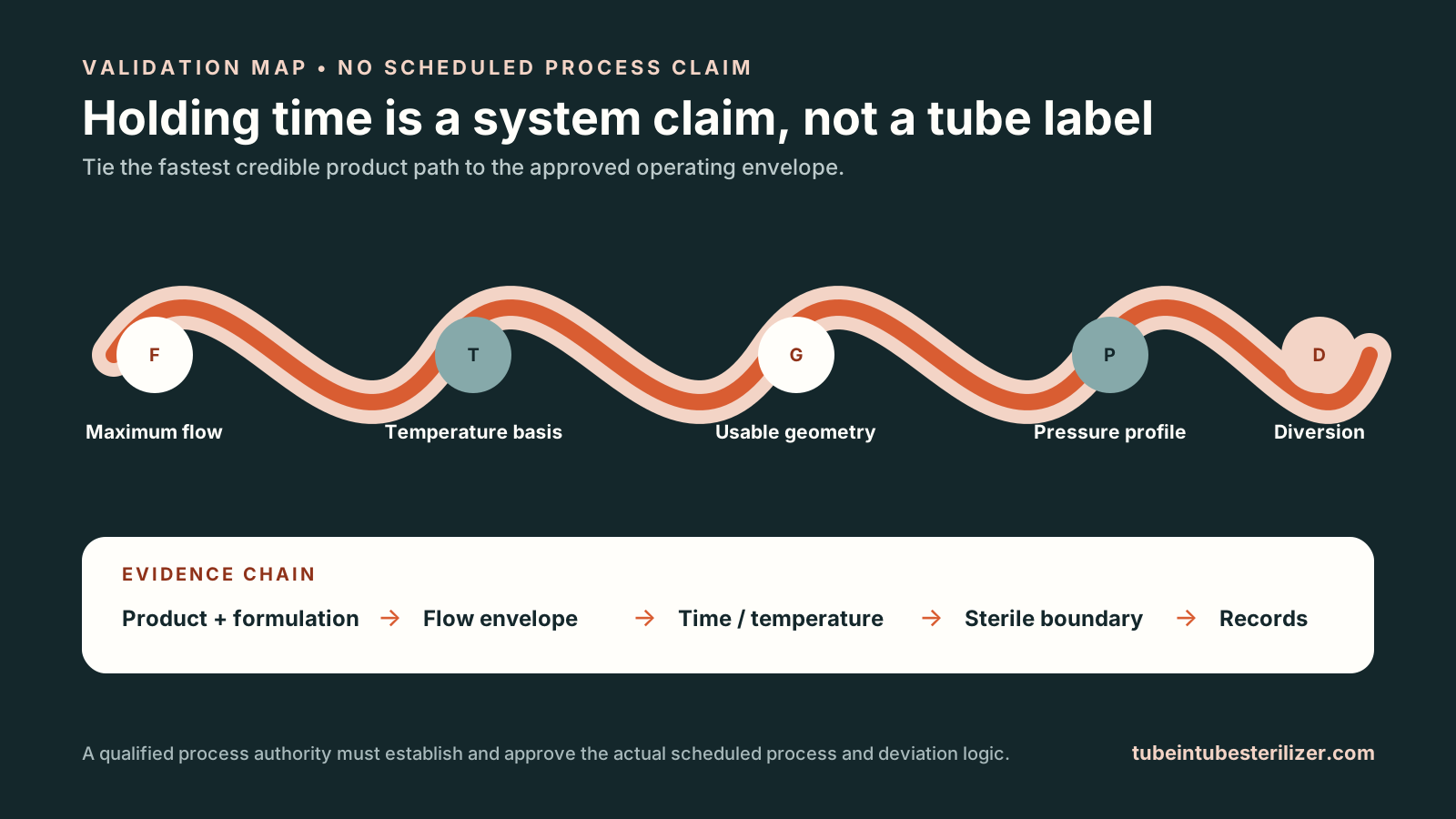
A holding tube provides a defined product path after heating, but compliance belongs to the scheduled process and its real operating envelope. Maximum permitted flow, usable geometry, flow behaviour, particles, instrumentation and deviation logic all affect the evidence.
Direct answer
Dividing usable internal volume by volumetric flow gives a nominal average residence time for an incompressible-flow screening calculation. It does not, by itself, establish the minimum time received by the fastest product element. The validation basis must address the applicable flow model, maximum permitted flow and the exact holding geometry.
For U.S. low-acid aseptic processing, FDA inspection guidance explicitly connects maximum flow rate to residence time and directs attention to the fastest moving product particle or element. Other products and markets may use different regulatory frameworks, but the same warning applies: this page is not a scheduled-process calculator.
Input boundary
Identify the qualified process basis, product/formulation scope, target condition and required minimum hold under the governing market rules.
Use the safety-relevant upper flow limit, not only nominal production throughput. Define the meter, control loop, tolerance and response.
Record internal diameter, actual length, fittings, slope, thermal expansion and any volume that the validated method excludes.
Use density and rheology at relevant conditions. Non-Newtonian behaviour can change velocity distribution and invalidate a borrowed factor.
For heterogeneous foods, particle motion and heat penetration may require additional evidence beyond the liquid-phase average.
Define flow and temperature measurement, calibration, recording, alarms, diversion, startup, shutdown and deviation disposition.
Evidence sequence
Record the formulation, particles, rheology and process-authority requirements that the design is intended to cover.
Make every internal dimension, volume, flow assumption and correction reviewable rather than hiding them in a headline hold time.
Select a justified method for the product and flow regime; use residence-time or product testing where calculation alone is insufficient.
Prove the flow meter, pump/control response and diversion logic prevent out-of-envelope product from entering the acceptable stream.
Preserve calculations, drawings, calibration, tests and approvals; reassess changes to product, flow, geometry or operating method.
Safety boundary
A nominal screening relationship can help identify missing inputs, but the qualified process basis, regulatory context, fastest-path method, exact geometry and control system determine whether the result is acceptable.
Primary sources
The FDA documents apply to U.S. low-acid aseptic processing; the particle study provides experimental context. None establishes a universal Site34 design.
Holding review
The correct output is an approved operating envelope with traceable assumptions and deviation logic—not a standalone length number.
Request a quotation