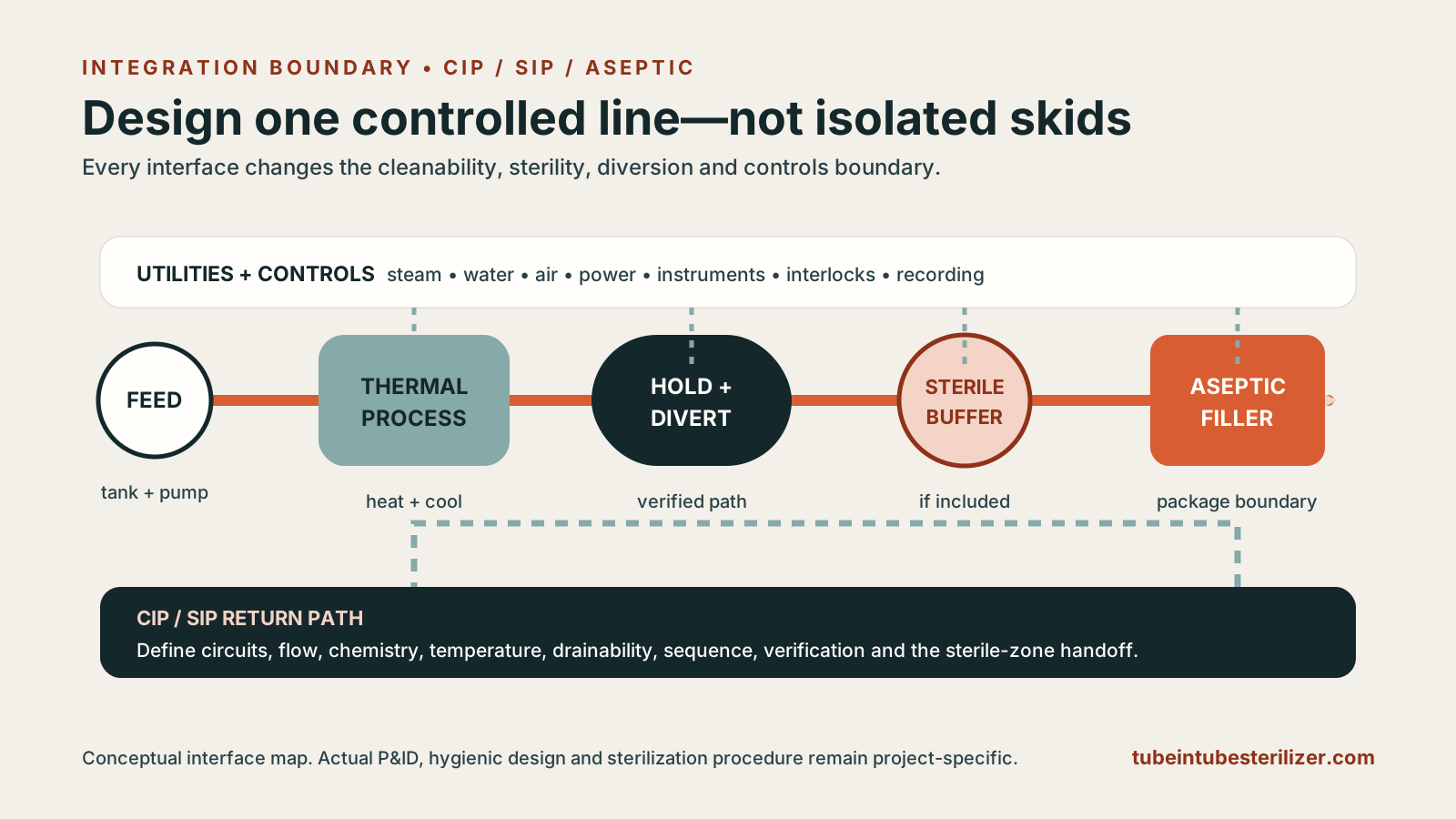
Projects often describe the tube-in-tube sterilizer as the thermal core and then treat the filler as a separate purchase. That can be commercially sensible, but it is not a complete process boundary. The FDA aseptic-processing guide states that a process authority must establish a process ensuring commercial sterility not only of the product but also of the product sterilization system and all equipment downstream from the holding tube, including the filler, the packaging equipment and the packaging material.
Draw the boundary from the hold tube to the package
Start at the holding tube and follow the product path forward. The cooling section, outlet valves, diversion path, aseptic surge tank if present, transfer pump, homogenizer if present, filler and package all sit somewhere on the route to a sealed container. The diagram should show where product is exposed, where a sterile barrier is intended and where a utility or atmosphere can enter.
The boundary also has a backward edge. Feed tanks, pumps and upstream processing may be outside the sterile zone, but their condition still affects what arrives at the sterilizer. A formulation change upstream can alter fouling, flow or the critical factors in the scheduled process. The review therefore has to connect the hygienic state of the feed to the process assumptions, without pretending that every upstream vessel is sterile.
Name every interface that can admit contamination
The FDA guide points to product coolers, aseptic surge tanks, flow-diversion valves, homogenizers and aseptic pumps as places where microorganisms can enter downstream of the holding tube. Rotating or reciprocating shafts and valve stems need steam seals or other effective barriers, and their performance has to be monitored. Aseptic surge tanks need a defined venting or air-purge schedule and sterile air or gas overpressure. Filter integrity belongs in the same conversation.
Those are not details to leave until commissioning. Each one is an interface with a supply responsibility. The quotation should say who provides the valve, seal, filter, sterile-air source, tank, transfer piping, instrument and control handshake. If the answer is “existing plant”, the project still needs evidence that the existing item can maintain the intended boundary.
Separate cleaning, sterilization and production states
CIP removes product soil from a defined circuit. SIP or another pre-sterilization step brings the defined sterile zone to the condition required before production. They are related but not interchangeable. A clean surface is not automatically a sterile surface, and a sterilization cycle is not a cleaning recipe.
The equipment review should map the circuits that are cleaned together, the circuits that are isolated, the return path and the verification method. It should also map the pre-sterilization sequence: which valves are open, where the sterilizing medium reaches, how air pockets are removed and how the transition to product is controlled. The FDA guide notes that a proper switchover from water to product must avoid a deviation in either the equipment-sterilization or the product-sterilization cycle.
Document deviations and who may restart
The FDA guide lists possible deviations including a temperature drop in the holding tube, loss of differential pressure in a product-to-product regenerator, loss of sterile air or gas pressure, loss of sterility in air or gas supplies and an increase in metering-pump speed. When a scheduled process is breached, affected product must be destroyed, reprocessed or segregated and held for evaluation. The processing and packaging system must also be cleaned and re-sterilized before operations resume.
A written escalation path is part of the boundary. Who detects the deviation? Who decides the product disposition? Who confirms that cleaning and re-sterilization are complete? Who authorizes the line to restart, and what record proves it? The answers should be agreed before the first production run, not improvised during an alarm.
Put the boundary into the supply scope
An equipment package can be technically capable and still leave a gap at the handover. The quotation should identify the sterilizer’s outlet condition, the transfer pressure, the sterile barrier, the downstream equipment and the controls that prevent an unacceptable transfer. If an aseptic tank or filler is buyer-supplied, the interface drawing and the responsibility matrix need the same attention as the sterilizer itself.
Ask for the documentation that will actually be issued: a general arrangement, a P&ID, a utility schedule, an instrument list, a control narrative and the acceptance tests. Ask which items are included, optional or excluded. A clear boundary is not a guarantee of commercial sterility or shelf life; it is the condition that makes a product-specific validation plan possible.
Questions for the next project review
Which equipment is inside the sterile zone, and which is merely adjacent? Where can air, water, steam, product or a mechanical shaft cross the boundary? How is each barrier monitored? What happens to product already in the line when a critical factor deviates? Which restart steps are automatic, and which require a person with defined authority?
These questions are more useful than a generic claim that a machine is “aseptic”. They force the project to describe the actual boundary, the evidence that maintains it and the responsibilities on both sides of the purchase order. That is the conversation a tube-in-tube sterilizer project needs before the first carton is filled.