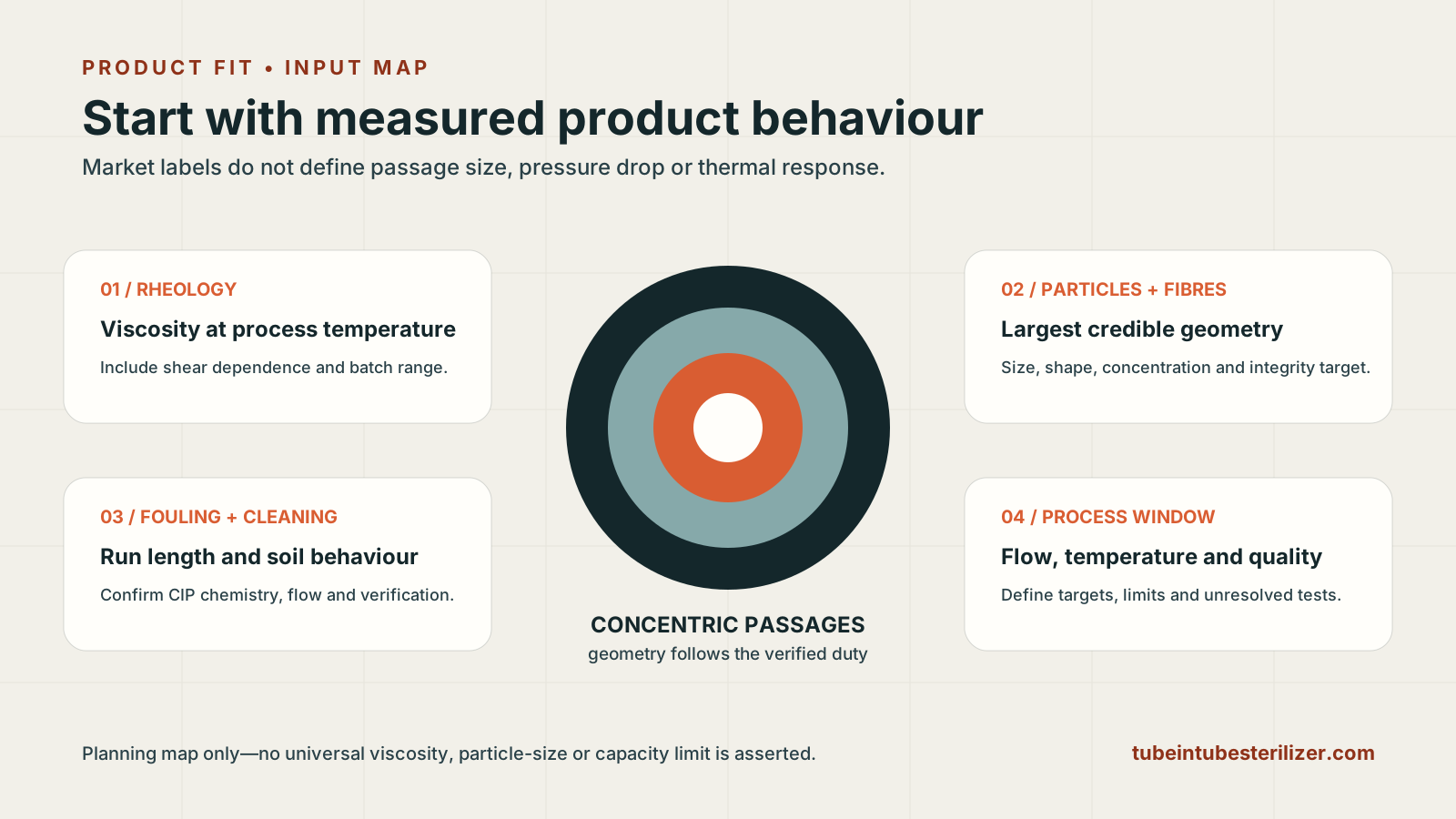
Equipment catalogues can describe a temperature capability, a holding-time adjustment range or a family of tubular geometries. They cannot decide whether a mango purée, a tomato paste or a particulate sauce will pass through a selected passage and receive the process its maker intends. That gap belongs in the trial brief, not in a later assumption.
A product name is not a trial specification
“Fruit purée” and “viscous sauce” are commercial descriptions. They do not tell a pump, a heat exchanger or a process authority how the product behaves at inlet temperature, at process temperature or after cooling. Two purées with the same fruit name can differ in fibre length, pulp fraction, soluble solids, acidity and the way viscosity changes with shear.
The U.S. FDA aseptic-processing inspection guide makes the same point in operational terms. It asks whether formulation changes, such as changing starch types or amounts, might affect the adequacy of the thermal process. For products with particulates, it directs attention to the critical factors identified by the processing authority, including particle size where that is a critical factor. These are process questions, not catalogue categories.
Write formulation, particles and rheology into the brief
A useful trial brief starts with the range the equipment may see, not only the easiest reference batch. Record the formulation family and credible batch variation. Include pH, soluble solids or Brix, density, inlet temperature and the intended outlet condition. Identify starch, protein, fat, sugar and any ingredient that can change fouling or flow behaviour.
For rheology, state the measurement method, temperature and shear conditions. A single room-temperature viscosity is rarely enough to describe a product that is heated, pumped and cooled. If the product is shear-thinning or time-dependent, the trial plan should acknowledge that the apparent viscosity at the wall and in the bulk may not be the same.
For particles and fibres, use three-axis dimensions, not only a nominal diameter. Add the size distribution, concentration, shape, hardness and the integrity target after processing. Fibre length and the tendency to bundle can matter as much as the largest single piece. The same discipline applies to pulp, skin, seeds or other material that must pass through the selected path.
Define thermal and flow evidence before booking a run
A tube-in-tube machine creates a flow path. The product-specific process establishes what must happen inside it. Where a scheduled process applies, the process authority defines the critical factors and the basis for commercial sterility. The equipment team then has to show that the installed arrangement can operate within those factors.
The FDA guide describes a continuous aseptic process as one in which flow through the holding tube determines residence time. It notes that the fastest-moving element is evaluated, not simply the average residence time, and that product flow rate should be monitored or verified as part of routine operation. It also warns that pumping rates established with water may not reflect the flow of a viscous food product.
Those points should shape the trial record. Which flow instrument is used, how it is calibrated and what product condition it sees are part of the evidence. So are pump type, minimum and maximum intended flow, holding-path configuration and the pressure relationships that keep the path full. A trial that reports only a temperature setpoint is incomplete.
Ask worst-case questions, not only the reference recipe
Worst case is product-specific. It may be the thickest formulation, the lowest intended flow, the largest particle, the longest run before cleaning or the batch with the greatest tendency to foul. It may also be a changeover condition: the residue left by one product and the cleaning step before the next.
List the credible extremes and explain why each is limiting. If the plant intends to run several fruit purées on one machine, include the full range rather than sizing only for the current bestseller. If the product is a low-acid food in a hermetically sealed container, the applicable regulatory category and filing questions belong in the project discussion; a catalogue temperature range does not answer them.
Ask what evidence the trial is meant to produce. A heat-transfer check, a pump and pressure check, a particle-integrity observation and a residence-time study are different exercises. Combining them into one undocumented run can leave the team with a result that is difficult to interpret or repeat.
Keep the machine range separate from the validated process
This site describes tube-in-tube equipment with adjustable catalogue references. Those references are useful for a first conversation about utilities, materials and configuration. They are not a universal product treatment, a validated throughput or a substitute for a process authority’s schedule.
The distinction matters commercially as well as technically. A quotation can define the heat-transfer area, pump, holding assembly, controls and downstream interface. It cannot promise that a particular formulation will be commercially sterile, retain a particular texture or achieve a shelf life without the product-specific validation work. Keep those responsibilities explicit in the trial plan.
A practical trial record
A reviewable record usually includes the representative formulation and batch history; measured rheology at relevant temperatures; particle and fibre distributions; the proposed flow range and its basis; inlet, target and outlet conditions; the holding-path definition; instrument calibration; cleaning state; and the agreed measurements before and after processing. Record deviations and changes to the plan while they are still visible, not after the report is written.
The most useful outcome is not a single “pass” label. It is a clearer boundary: which product conditions the equipment can be expected to handle, which values remain uncertain and which tests must precede a commercial commitment. That boundary is what lets a sterilizer trial support an equipment decision instead of replacing it.